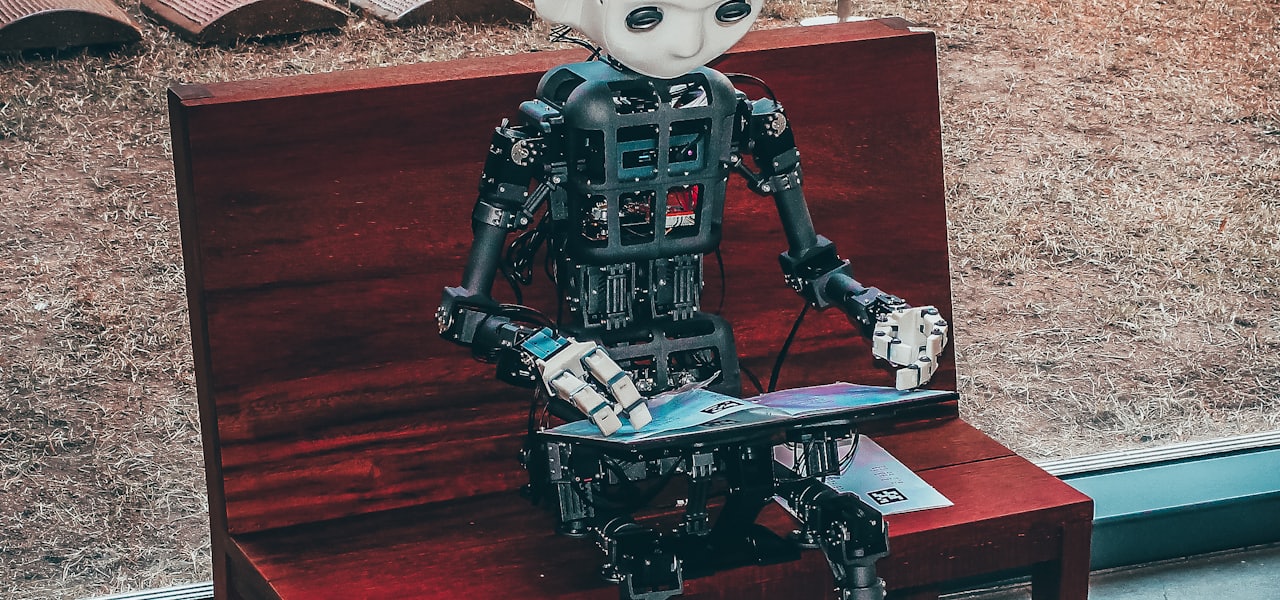
The Mark I Perceptron was a pioneering supervised image classification learning system developed by Frank Rosenblatt in 1958. It was the first implementation of an artificial intelligence (AI) machine. It differs from the Perceptron which is a software architecture proposed in 1943 by Warren McCulloch and Walter Pitts, which was also employed in Mark I, and enhancements of which have continued to be an integral part of cutting edge AI technologies like the Transformer. == Architecture == The Mark I Perceptron was organized into three layers: A set of sensory units which receive optical input A set of association units, each of which fire based on input from multiple sensory units A set of response units, which fire based on input from multiple association units The connection between sensory units and association units were random. The working of association units was very similar to the response units. Different versions of the Mark I used different numbers of units in each of the layers. == Capabilities == In his 1957 proposal for funding for development of the "Cornell Photoperceptron", Rosenblatt claimed:"Devices of this sort are expected ultimately to be capable of concept formation, language translation, collation of military intelligence, and the solution of problems through inductive logic."With the first version of the Mark I Perceptron as early as 1958, Rosenblatt demonstrated a simple binary classification experiment, namely distinguishing between sheets of paper marked on the right versus those marked on the left side. One of the later experiments distinguished a square from a circle printed on paper. The shapes were perfect and their sizes fixed; the only variation was in their position and orientation. The Mark I Perceptron achieved 99.8% accuracy on a test dataset with 500 neurons in a single layer. The size of the training dataset was 10,000 example images. It took 3 seconds for the training pipeline to go through a single image. Higher accuracy was observed with thick outline figures compared to solid figures, likely because outline figures reduced overfitting. Another experiment distinguished between a square and a diamond for which 100% accuracy was achieved with only 60 training images, with a Perceptron having 1,000 neurons in a single layer. The time taken to process each training input for this larger perceptron was 15 seconds. The only variation was in position of the image, since rotation would have been ambiguous. In that same experiment, it could distinguish between the letters X and E with 100% accuracy when trained with only 20 images (10 images of each letter). Variations in the images included both position and rotation by up to 30 degrees. When variation in rotation was increased to any angle (both in training and test datasets), the accuracy reduced to 90% with 60 training images (30 images of each letter). For distinguishing between the letters E and F, a more challenging problem due to their similarity, the same 1,000 neuron perceptron achieved an accuracy of more than 80% with 60 training images. Variation was only in the position of the image, with no rotation.
Highway network
In machine learning, the Highway Network was the first working very deep feedforward neural network with hundreds of layers, much deeper than previous neural networks. It uses skip connections modulated by learned gating mechanisms to regulate information flow, inspired by long short-term memory (LSTM) recurrent neural networks. The advantage of the Highway Network over other deep learning architectures is its ability to overcome or partially prevent the vanishing gradient problem, thus improving its optimization. Gating mechanisms are used to facilitate information flow across the many layers ("information highways"). Highway Networks have found use in text sequence labeling and speech recognition tasks. In 2014, the state of the art was training deep neural networks with 20 to 30 layers. Stacking too many layers led to a steep reduction in training accuracy, known as the "degradation" problem. In 2015, two techniques were developed to train such networks: the Highway Network (published in May), and the residual neural network, or ResNet (December). ResNet behaves like an open-gated Highway Net. == Model == The model has two gates in addition to the H ( W H , x ) {\displaystyle H(W_{H},x)} gate: the transform gate T ( W T , x ) {\displaystyle T(W_{T},x)} and the carry gate C ( W C , x ) {\displaystyle C(W_{C},x)} . The latter two gates are non-linear transfer functions (specifically sigmoid by convention). The function H {\displaystyle H} can be any desired transfer function. The carry gate is defined as: C ( W C , x ) = 1 − T ( W T , x ) {\displaystyle C(W_{C},x)=1-T(W_{T},x)} while the transform gate is just a gate with a sigmoid transfer function. == Structure == The structure of a hidden layer in the Highway Network follows the equation: y = H ( x , W H ) ⋅ T ( x , W T ) + x ⋅ C ( x , W C ) = H ( x , W H ) ⋅ T ( x , W T ) + x ⋅ ( 1 − T ( x , W T ) ) {\displaystyle {\begin{aligned}y=H(x,W_{H})\cdot T(x,W_{T})+x\cdot C(x,W_{C})\\=H(x,W_{H})\cdot T(x,W_{T})+x\cdot (1-T(x,W_{T}))\end{aligned}}} == Related work == Sepp Hochreiter analyzed the vanishing gradient problem in 1991 and attributed to it the reason why deep learning did not work well. To overcome this problem, Long Short-Term Memory (LSTM) recurrent neural networks have residual connections with a weight of 1.0 in every LSTM cell (called the constant error carrousel) to compute y t + 1 = F ( x t ) + x t {\textstyle y_{t+1}=F(x_{t})+x_{t}} . During backpropagation through time, this becomes the residual formula y = F ( x ) + x {\textstyle y=F(x)+x} for feedforward neural networks. This enables training very deep recurrent neural networks with a very long time span t. A later LSTM version published in 2000 modulates the identity LSTM connections by so-called "forget gates" such that their weights are not fixed to 1.0 but can be learned. In experiments, the forget gates were initialized with positive bias weights, thus being opened, addressing the vanishing gradient problem. As long as the forget gates of the 2000 LSTM are open, it behaves like the 1997 LSTM. The Highway Network of May 2015 applies these principles to feedforward neural networks. It was reported to be "the first very deep feedforward network with hundreds of layers". It is like a 2000 LSTM with forget gates unfolded in time, while the later Residual Nets have no equivalent of forget gates and are like the unfolded original 1997 LSTM. If the skip connections in Highway Networks are "without gates," or if their gates are kept open (activation 1.0), they become Residual Networks. The residual connection is a special case of the "short-cut connection" or "skip connection" by Rosenblatt (1961) and Lang & Witbrock (1988) which has the form x ↦ F ( x ) + A x {\displaystyle x\mapsto F(x)+Ax} . Here the randomly initialized weight matrix A does not have to be the identity mapping. Every residual connection is a skip connection, but almost all skip connections are not residual connections. The original Highway Network paper not only introduced the basic principle for very deep feedforward networks, but also included experimental results with 20, 50, and 100 layers networks, and mentioned ongoing experiments with up to 900 layers. Networks with 50 or 100 layers had lower training error than their plain network counterparts, but no lower training error than their 20 layers counterpart (on the MNIST dataset, Figure 1 in ). No improvement on test accuracy was reported with networks deeper than 19 layers (on the CIFAR-10 dataset; Table 1 in ). The ResNet paper, however, provided strong experimental evidence of the benefits of going deeper than 20 layers. It argued that the identity mapping without modulation is crucial and mentioned that modulation in the skip connection can still lead to vanishing signals in forward and backward propagation (Section 3 in ). This is also why the forget gates of the 2000 LSTM were initially opened through positive bias weights: as long as the gates are open, it behaves like the 1997 LSTM. Similarly, a Highway Net whose gates are opened through strongly positive bias weights behaves like a ResNet. The skip connections used in modern neural networks (e.g., Transformers) are dominantly identity mappings.
Linked timestamping
Linked timestamping is a type of trusted timestamping where issued time-stamps are related to each other. Each time-stamp would contain data that authenticates the time-stamp before it, the authentication would be authenticating the entire message, including the previous time-stamps authentication, making a chain. This makes it impossible to add a time-stamp in to the middle of the chain, as any time-stamps afterwards would be different. == Description == Linked timestamping creates time-stamp tokens which are dependent on each other, entangled in some authenticated data structure. Later modification of the issued time-stamps would invalidate this structure. The temporal order of issued time-stamps is also protected by this data structure, making backdating of the issued time-stamps impossible, even by the issuing server itself. The top of the authenticated data structure is generally published in some hard-to-modify and widely witnessed media, like printed newspaper or public blockchain. There are no (long-term) private keys in use, avoiding PKI-related risks. Suitable candidates for the authenticated data structure include: Linear hash chain Merkle tree (binary hash tree) Skip list The simplest linear hash chain-based time-stamping scheme is illustrated in the following diagram: The linking-based time-stamping authority (TSA) usually performs the following distinct functions: Aggregation For increased scalability the TSA might group time-stamping requests together which arrive within a short time-frame. These requests are aggregated together without retaining their temporal order and then assigned the same time value. Aggregation creates a cryptographic connection between all involved requests; the authenticating aggregate value will be used as input for the linking operation. Linking Linking creates a verifiable and ordered cryptographic link between the current and already issued time-stamp tokens. Publishing The TSA periodically publishes some links, so that all previously issued time-stamp tokens depend on the published link and that it is practically impossible to forge the published values. By publishing widely witnessed links, the TSA creates unforgeable verification points for validating all previously issued time-stamps. == Security == Linked timestamping is inherently more secure than the usual, public-key signature based time-stamping. All consequential time-stamps "seal" previously issued ones - hash chain (or other authenticated dictionary in use) could be built only in one way; modifying issued time-stamps is nearly as hard as finding a preimage for the used cryptographic hash function. Continuity of operation is observable by users; periodic publications in widely witnessed media provide extra transparency. Tampering with absolute time values could be detected by users, whose time-stamps are relatively comparable by system design. Absence of secret keys increases system trustworthiness. There are no keys to leak and hash algorithms are considered more future-proof than modular arithmetic based algorithms, e.g. RSA. Linked timestamping scales well - hashing is much faster than public key cryptography. There is no need for specific cryptographic hardware with its limitations. The common technology for guaranteeing long-term attestation value of the issued time-stamps (and digitally signed data) is periodic over-time-stamping of the time-stamp token. Because of missing key-related risks and of the plausible safety margin of the reasonably chosen hash function this over-time-stamping period of hash-linked token could be an order of magnitude longer than of public-key signed token. == Research == === Foundations === Stuart Haber and W. Scott Stornetta proposed in 1990 to link issued time-stamps together into linear hash-chain, using a collision-resistant hash function. The main rationale was to diminish TSA trust requirements. Tree-like schemes and operating in rounds were proposed by Benaloh and de Mare in 1991 and by Bayer, Haber and Stornetta in 1992. Benaloh and de Mare constructed a one-way accumulator in 1994 and proposed its use in time-stamping. When used for aggregation, one-way accumulator requires only one constant-time computation for round membership verification. Surety started the first commercial linked timestamping service in January 1995. Linking scheme is described and its security is analyzed in the following article by Haber and Sornetta. Buldas et al. continued with further optimization and formal analysis of binary tree and threaded tree based schemes. Skip-list based time-stamping system was implemented in 2005; related algorithms are quite efficient. === Provable security === Security proof for hash-function based time-stamping schemes was presented by Buldas, Saarepera in 2004. There is an explicit upper bound N {\displaystyle N} for the number of time stamps issued during the aggregation period; it is suggested that it is probably impossible to prove the security without this explicit bound - the so-called black-box reductions will fail in this task. Considering that all known practically relevant and efficient security proofs are black-box, this negative result is quite strong. Next, in 2005 it was shown that bounded time-stamping schemes with a trusted audit party (who periodically reviews the list of all time-stamps issued during an aggregation period) can be made universally composable - they remain secure in arbitrary environments (compositions with other protocols and other instances of the time-stamping protocol itself). Buldas, Laur showed in 2007 that bounded time-stamping schemes are secure in a very strong sense - they satisfy the so-called "knowledge-binding" condition. The security guarantee offered by Buldas, Saarepera in 2004 is improved by diminishing the security loss coefficient from N {\displaystyle N} to N {\displaystyle {\sqrt {N}}} . The hash functions used in the secure time-stamping schemes do not necessarily have to be collision-resistant or even one-way; secure time-stamping schemes are probably possible even in the presence of a universal collision-finding algorithm (i.e. universal and attacking program that is able to find collisions for any hash function). This suggests that it is possible to find even stronger proofs based on some other properties of the hash functions. At the illustration above hash tree based time-stamping system works in rounds ( t {\displaystyle t} , t + 1 {\displaystyle t+1} , t + 2 {\displaystyle t+2} , ...), with one aggregation tree per round. Capacity of the system ( N {\displaystyle N} ) is determined by the tree size ( N = 2 l {\displaystyle N=2^{l}} , where l {\displaystyle l} denotes binary tree depth). Current security proofs work on the assumption that there is a hard limit of the aggregation tree size, possibly enforced by the subtree length restriction. == Standards == ISO 18014 part 3 covers 'Mechanisms producing linked tokens'. American National Standard for Financial Services, "Trusted Timestamp Management and Security" (ANSI ASC X9.95 Standard) from June 2005 covers linking-based and hybrid time-stamping schemes. There is no IETF RFC or standard draft about linking based time-stamping. RFC 4998 (Evidence Record Syntax) encompasses hash tree and time-stamp as an integrity guarantee for long-term archiving.
Immediate mode (computer graphics)
Immediate mode is an API design pattern in computer graphics libraries, in which the client calls directly cause rendering of graphics objects to the display, or in which the data to describe rendering primitives is inserted frame by frame directly from the client into a command list (in the case of immediate mode primitive rendering), without the use of extensive indirection – thus immediate – to retained resources. It does not preclude the use of double-buffering. Retained mode is an alternative approach. Historically, retained mode has been the dominant style in GUI libraries; however, both can coexist in the same library and are not necessarily exclusive in practice. == Overview == In immediate mode, the scene (complete object model of the rendering primitives) is retained in the memory space of the client, instead of the graphics library. This implies that in an immediate mode application, the lists of graphical objects to be rendered are kept by the client and are not saved by the graphics library API. The application must re-issue all drawing commands required to describe the entire scene each time a new frame is required, regardless of actual changes. This method provides on the one hand a maximum of control and flexibility to the application program, but on the other hand it also generates continuous work load on the CPU. Examples of immediate mode rendering systems include Direct2D, OpenGL and Quartz. There are some immediate mode GUIs that are particularly suitable when used in conjunction with immediate mode rendering systems. == Immediate mode primitive rendering == Primitive vertex attribute data may be inserted frame by frame into a command buffer by a rendering API. This involves significant bandwidth and processor time (especially if the graphics processing unit is on a separate bus), but may be advantageous for data generated dynamically by the CPU. It is less common since the advent of increasingly versatile shaders, with which a graphics processing unit may generate increasingly complex effects without the need for CPU intervention. == Immediate mode rendering with vertex buffers == Although drawing commands have to be re-issued for each new frame, modern systems using this method are generally able to avoid the unnecessary duplication of more memory-intensive display data by referring to that unchanging data (via indirection) (e.g. textures and vertex buffers) in the drawing commands. == Immediate mode GUI == Graphical user interfaces traditionally use retained mode-style API design, but immediate mode GUIs instead use an immediate mode-style API design, in which user code directly specifies the GUI elements to draw in the user input loop. For example, rather than having a CreateButton() function that a user would call once to instantiate a button, an immediate-mode GUI API may have a DoButton() function which should be called whenever the button should be on screen. The technique was developed by Casey Muratori in 2002. Prominent implementations include Omar Cornut's Dear ImGui in C++, Nic Barker's Clay in C and Micha Mettke's Nuklear in C.
Visual analytics
Visual analytics is a multidisciplinary science and technology field that emerged from information visualization and scientific visualization. It focuses on how analytical reasoning can be facilitated by interactive visual interfaces. == Overview == Visual analytics is "the science of analytical reasoning facilitated by interactive visual interfaces." It can address problems whose size, complexity, and need for closely coupled human and machine analysis may make them otherwise intractable. Visual analytics advances scientific and technological development across multiple domains, including analytical reasoning, human–computer interaction, data transformations, visual representation for computation and analysis, analytic reporting, and the transition of new technologies into practice. As a research agenda, visual analytics brings together several scientific and technical communities from computer science, information visualization, cognitive and perceptual sciences, interactive design, graphic design, and social sciences. Visual analytics integrates new computational and theory-based tools with innovative interactive techniques and visual representations to enable human-information discourse. The design of the tools and techniques is based on cognitive, design, and perceptual principles. This science of analytical reasoning provides the reasoning framework upon which one can build both strategic and tactical visual analytics technologies for threat analysis, prevention, and response. Analytical reasoning is central to the analyst's task of applying human judgments to reach conclusions from a combination of evidence and assumptions. Visual analytics has some overlapping goals and techniques with information visualization and scientific visualization. There is currently no clear consensus on the boundaries between these fields, but broadly speaking the three areas can be distinguished as follows: Scientific visualization deals with data that has a natural geometric structure (e.g., MRI data, wind flows). Information visualization handles abstract data structures such as trees or graphs. Visual analytics is especially concerned with coupling interactive visual representations with underlying analytical processes (e.g., statistical procedures, data mining techniques) such that high-level, complex activities can be effectively performed (e.g., sense making, reasoning, decision making). Visual analytics seeks to marry techniques from information visualization with techniques from computational transformation and analysis of data. Information visualization forms part of the direct interface between user and machine, amplifying human cognitive capabilities in six basic ways: by increasing cognitive resources, such as by using a visual resource to expand human working memory, by reducing search, such as by representing a large amount of data in a small space, by enhancing the recognition of patterns, such as when information is organized in space by its time relationships, by supporting the easy perceptual inference of relationships that are otherwise more difficult to induce, by perceptual monitoring of a large number of potential events, and by providing a manipulable medium that, unlike static diagrams, enables the exploration of a space of parameter values These capabilities of information visualization, combined with computational data analysis, can be applied to analytic reasoning to support the sense-making process. == History == As an interdisciplinary approach, visual analytics has its roots in information visualization, cognitive sciences, and computer science. The term and scope of the field was defined in the early 2000s through researchers such as Jim Thomas, Kristin A. Cook, John Stasko, Pak Chung Wong, Daniel A. Keim and David S. Ebert. As a reaction to the September 11, 2001 attacks the United States Department of Homeland Security was established in late 2002, combining dozens of previously separated government agencies. Building upon earlier work on visual data mining by Daniel A. Keim starting in the late 1990s, this simultaneously lead to the development of a research agenda for visual analytics. As part of these efforts the National Visualization and Analytics Center (NVAC) at Pacific Northwest National Laboratory was established in 2004, whose charter was to develop system to mitigate information overload after the September 11, 2001 attacks in the intelligence community. Their research work determined core challenges, posed open research questions, and positioned visual analytics as a new research domain, in particular through the 2005 research agenda Illuminating the Path. In 2006, the IEEE VIS community led by Pak Chung Wong and Daniel A. Keim launched the annual IEEE Conference on Visual Analytics Science and Technology (VAST), providing a dedicated venue for research into visual analytics, which in 2020 merged to form the IEEE Visualization conference. In 2008, scope and challenges of visual analytics were conceptually defined by Daniel A. Keim and Jim Thomas in their influential book about visual data mining. The domain was further refined as part of the European Commissions FP7 VisMaster program in the late 2000s. == Topics == === Scope === Visual analytics is a multidisciplinary field that includes the following focus areas: Analytical reasoning techniques that enable users to obtain deep insights that directly support assessment, planning, and decision making Data representations and transformations that convert all types of conflicting and dynamic data in ways that support visualization and analysis Techniques to support production, presentation, and dissemination of the results of an analysis to communicate information in the appropriate context to a variety of audiences. Visual representations and interaction techniques that take advantage of the human eye's broad bandwidth pathway into the mind to allow users to see, explore, and understand large amounts of information at once. === Analytical reasoning techniques === Analytical reasoning techniques are the method by which users obtain deep insights that directly support situation assessment, planning, and decision making. Visual analytics must facilitate high-quality human judgment with a limited investment of the analysts’ time. Visual analytics tools must enable diverse analytical tasks such as: Understanding past and present situations quickly, as well as the trends and events that have produced current conditions Identifying possible alternative futures and their warning signs Monitoring current events for emergence of warning signs as well as unexpected events Determining indicators of the intent of an action or an individual Supporting the decision maker in times of crisis. These tasks will be conducted through a combination of individual and collaborative analysis, often under extreme time pressure. Visual analytics must enable hypothesis-based and scenario-based analytical techniques, providing support for the analyst to reason based on the available evidence. === Data representations === Data representations are structured forms suitable for computer-based transformations. These structures must exist in the original data or be derivable from the data themselves. They must retain the information and knowledge content and the related context within the original data to the greatest degree possible. The structures of underlying data representations are generally neither accessible nor intuitive to the user of the visual analytics tool. They are frequently more complex in nature than the original data and are not necessarily smaller in size than the original data. The structures of the data representations may contain hundreds or thousands of dimensions and be unintelligible to a person, but they must be transformable into lower-dimensional representations for visualization and analysis. === Theories of visualization === Theories of visualization include: Jacques Bertin's Semiology of Graphics (1967) Nelson Goodman's Languages of Art (1977) Jock D. Mackinlay's Automated design of optimal visualization (APT) (1986) Leland Wilkinson's Grammar of Graphics (1998) Hadley Wickham's Layered Grammar of Graphics (2010) === Visual representations === Visual representations translate data into a visible form that highlights important features, including commonalities and anomalies. These visual representations make it easy for users to perceive salient aspects of their data quickly. Augmenting the cognitive reasoning process with perceptual reasoning through visual representations permits the analytical reasoning process to become faster and more focused. == Process == The input for the data sets used in the visual analytics process are heterogeneous data sources (i.e., the internet, newspapers, books, scientific experiments, expert systems). From these rich sources, the data sets S = S1, ..., Sm are chosen, whereas each Si , i ∈ (1, ..., m) consists of attrib
Graphics software
In computer graphics, graphics software refers to a program or collection of programs that enable a person to manipulate images or models visually on a computer. Computer graphics can be classified into two distinct categories: raster graphics and vector graphics, with further 2D and 3D variants. Many graphics programs focus exclusively on either vector or raster graphics, but there are a few that operate on both. It is simple to convert from vector graphics to raster graphics, but going the other way is harder. Some software attempts to do this. In addition to static graphics, there are animation and video editing software. Different types of software are often designed to edit different types of graphics such as video, photos, and vector-based drawings. The exact sources of graphics may vary for different tasks, but most can read and write files. Most graphics programs have the ability to import and export one or more graphics file formats, including those formats written for a particular computer graphics program. Such programs include, but are not limited to: GIMP, Adobe Photoshop, CorelDRAW, Microsoft Publisher, Picasa, etc. The use of a swatch is a palette of active colours that are selected and rearranged by the preference of the user. A swatch may be used in a program or be part of the universal palette on an operating system. It is used to change the colour of a text or image and in video editing. Vector graphics animation can be described as a series of mathematical transformations that are applied in sequence to one or more shapes in a scene. Raster graphics animation works in a similar fashion to film-based animation, where a series of still images produces the illusion of continuous movement. == History == SuperPaint was one of the earliest graphics software applications, first conceptualized in 1972 and achieving its first stable image in 1973 Fauve Matisse (later Macromedia xRes) was a pioneering program of the early 1990s, notably introducing layers in customer software. Currently Adobe Photoshop is one of the most used and best-known graphics programs in the Americas, having created more custom hardware solutions in the early 1990s, but was initially subject to various litigation. GIMP is a popular open-source alternative to Adobe Photoshop.
Groover
Groover is an online platform, record label and distributor, connecting artists and musicians with music professionals and media outlets. The service was founded in 2018 in France and operates from offices in Paris and New York. The platform has over 3,000 active contacts, including SPIN Magazine and Sofar Sounds. Groover uses a micro-payment model. Among the platform's over 500,000 regular users are record labels such as Ninja Tune, Ba Da Bing Records, Dance To The Radio, Roche Musique, Wagram Music, Secret City Records, and artists including Bonobo, Michael Bolton, Aloe Blacc, Haddaway, Passenger, La Femme and Chinese Man. == History == Groover was launched at the MaMA Music Convention in October 2018. It was co-founded by Dorian Perron, Romain Palmieri, and Rafaël Cohen while they were students at UC Berkeley. Initially growing in France, the company has expanded to the United States, Canada, the United Kingdom, Brazil, Italy, and elsewhere in Europe. In March 2019, Groover was part of the Business France delegation at the South by Southwest (SXSW) festival. In June 2019, Groover raised €1.3 million from various angel investors. In April 2021, Groover acquired the platform Soonvibes, which had 70,000 users at the time, in order to strengthen its community in the electronic music space. In November 2021, Groover announced a €6 million funding round from Bpifrance Creative Industries and Partech. Between 2023 and 2025, Groover entered strategic partnerships with major artist service providers, including CD Baby, TuneCore, SoundCloud, UnitedMasters, Symphonic Distribution, Audiomack and SACEM. In February 2024, Groover announced a Series A funding round of $8 million from OneRagTime, Trind, Techmind, and Mozza Angels. == Function == Using a micro-payment system, professionals listen to tracks and provide written feedback. These professionals retain full editorial independence and are under no obligation to share the track or contact the artist. == Awards == 2nd Prize for Music Innovation 2023 from the Centre national de la musique (France) "Future Creator" Award at the Petit Poucet Competition 2019 Jury's Special Mention at the MaMA Invent 2019 competition 1st Prize for Digital Initiative in Culture, Communication & Media 2019 awarded by Audiens "Start-up of the Year" at the Social Music Awards 2020 French American Entrepreneurship Award 2022 at the French Consulate in New York